The Carfax VIN decoder instantly reveals vehicle year, make, country of origin, vehicle type, and assembly plant. The tool operates free, with no sign-up required.
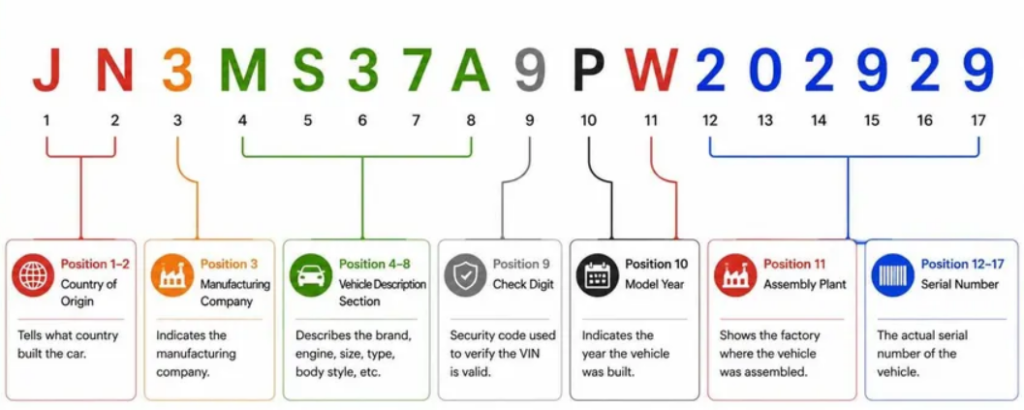
What Is a VIN?
A Vehicle Identification Number (VIN) is a unique 17-character code assigned to every car, truck, or SUV built for or sold in the United States. Each character encodes a specific detail about the vehicle, from the manufacturer and country of assembly to the model year and body style. Decoding a VIN is different from pulling a full vehicle history report: decoding tells you what the vehicle was built as, while a history report tells you what happened to it after it left the factory.
What Our Free VIN Decoder Reveals
A single VIN decode returns seven data categories:
- Decode status — confirms VIN validity and flags lookup errors.
- Core specifications — make, model, model year, vehicle type, body class, doors, trim, and series.
- Manufacturing details — manufacturer, plant country, plant city, and plant company.
- Powertrain data — engine cylinders, displacement, horsepower, fuel type, transmission style, gear count, drive type, and electrification level.
- Dimension data — GVWR, curb weight, wheelbase, and seating capacity.
- Safety data — airbag locations, seat belt type, ABS, stability control, TPMS, and driver-assist systems.
- Additional fields — EV battery specs, or motorcycle, bus, and trailer details, depending on vehicle type.
Where to Find Your VIN
Your VIN is stamped or printed in several places on the vehicle and its paperwork:
- Dashboard, visible through the windshield on the driver’s side
- Driver’s side door jamb sticker
- Vehicle registration document
- Insurance card or policy paperwork
- Vehicle title
- Stamped on the engine block
Need More Than Basic VIN Info?
A VIN decode tells you what the vehicle was built as. It won’t tell you about accidents, past owners, service records, or title issues. For that, get a complete Carfax report.
Order Complete CarfaxFAQ
Is a VIN decoder the same as a Carfax report?
No. A VIN decoder reveals how the vehicle was built at the factory — make, model, engine, and trim. A Carfax report adds what happened to it after that, including accidents, ownership changes, and service history.
Is this VIN decoder free and accurate?
Yes. It decodes data reported to the U.S. National Highway Traffic Safety Administration (NHTSA) and reliably covers vehicles built for or sold in the United States. Older, gray-market, or non-U.S. vehicles may decode partially or not at all.
Does the VIN decoder work for every vehicle?
It covers cars, trucks, SUVs, motorcycles, and trailers built for the U.S. market. Coverage for imports and vehicles older than 1981 (before the 17-character VIN standard) can be limited.
Do I need to sign up to use the decoder?
No sign-up is required. Enter a 17-character VIN and get results instantly.